Case study · Custom ERP · A family dairy
From paper logbooks to one system that sees the whole dairy
A family dairy, milk from its own farm, cheeses, yoghurts and desserts. In 15 weeks we built it an ERP that ties together milk, production, stock, dispatch, money and quality. On a computer and on a phone right at the line.
- screens in the application
216
screens in the application
- connected services and devices
18
connected services and devices
- releases deployed
2,169
releases deployed
- from first line of code to full operation
15 weeks
from first line of code to full operation
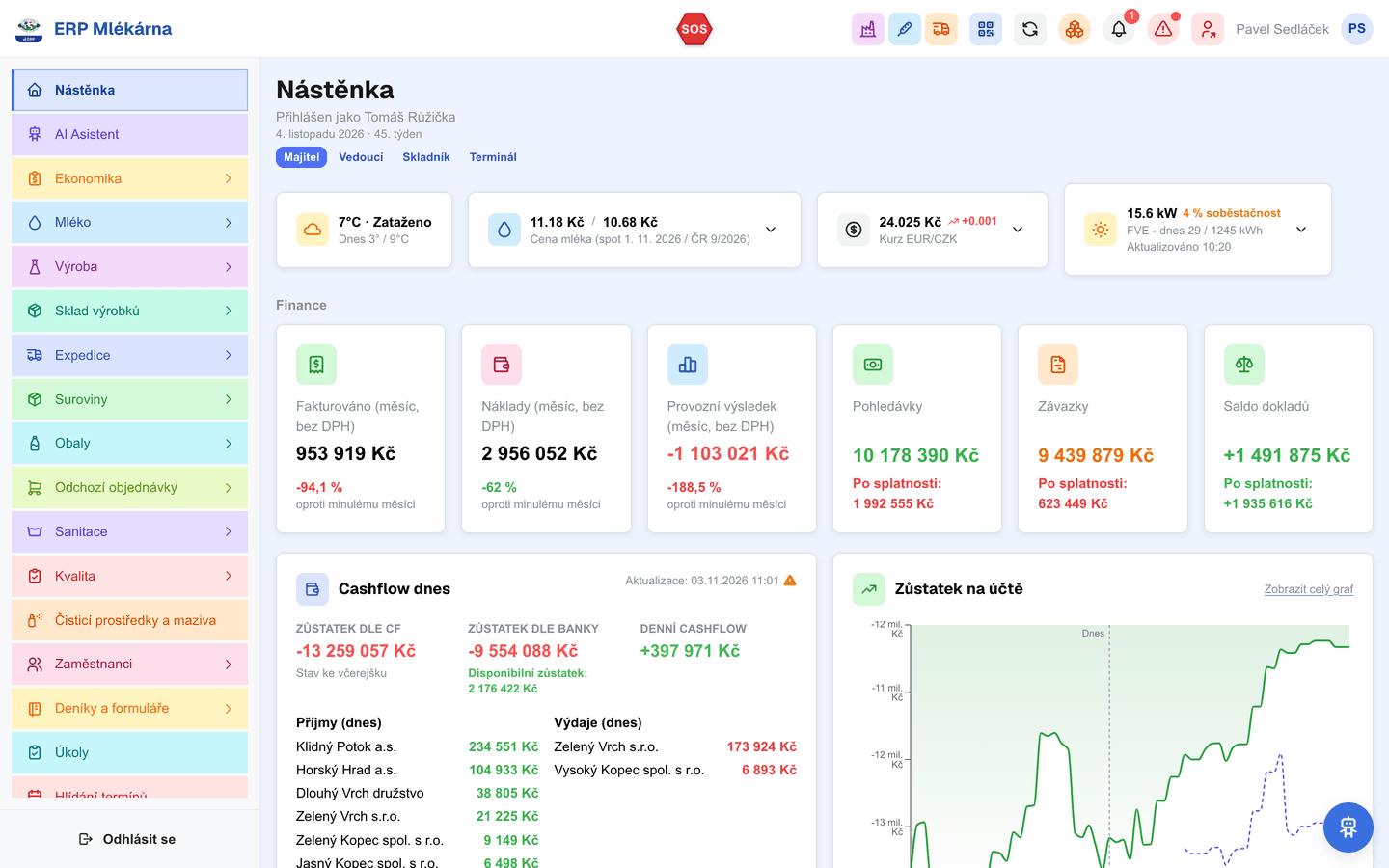
The starting point
What it was like before
An old application, paper, spreadsheets and five separate services. Every figure was written down several times.
An outdated production application
Years of data, but no phone access, no batches and no link to accounting.
Paper logbooks and IFS forms
Sanitation, calibration, checks and audits in ring binders. Before an audit someone had to find out who signed what.
Islands with nothing between them
Attendance, invoices and the bank each on their own. The monthly result was assembled by hand in spreadsheets.
Orders and stock from memory
Packaging running out was discovered only when it was missing at the line.
What we built
Twelve areas, one database
Built around how the dairy actually works. A remark in the morning, the fix in operation by the afternoon.
Milk
Intake, pasteurisation, milk flow
Temperature, pH, biotest and pasteurisation confirmed by a chip.
Production
Recipes, batches, planning
The recipe writes off the ingredients itself; the plan works out what to buy.
Warehouses
Products, ingredients, packaging
Batches, stocktakes, labels and stock watch.
Dispatch
Delivery notes and transport
A delivery note with scanned batches, and an invoice on top.
Purchasing
Order builder
An order to a supplier in a few clicks.
Finance
Result, cash flow, invoices
The monthly result, cash flow and payments from the bank.
Quality
Inspections, audits, allergens
Inspections, audits, complaints and allergens derived from recipes.
IFS documentation
Controlled documents and the consultant
Versioned documents; the consultant gets read-only access.
Sanitation and logbooks
CCP, CIP, traps, calibration
Logbooks instead of binders, with deadlines watched for you.
People
Attendance, payroll, standards
Attendance, payroll and how standards are being met.
Operations
A live map and tasks
A live map of the dairy and tasks on the shop-floor terminal.
AI assistant
Ask instead of search
Ask and it answers. It enters e-mailed orders on its own.
Production
Every batch traceable
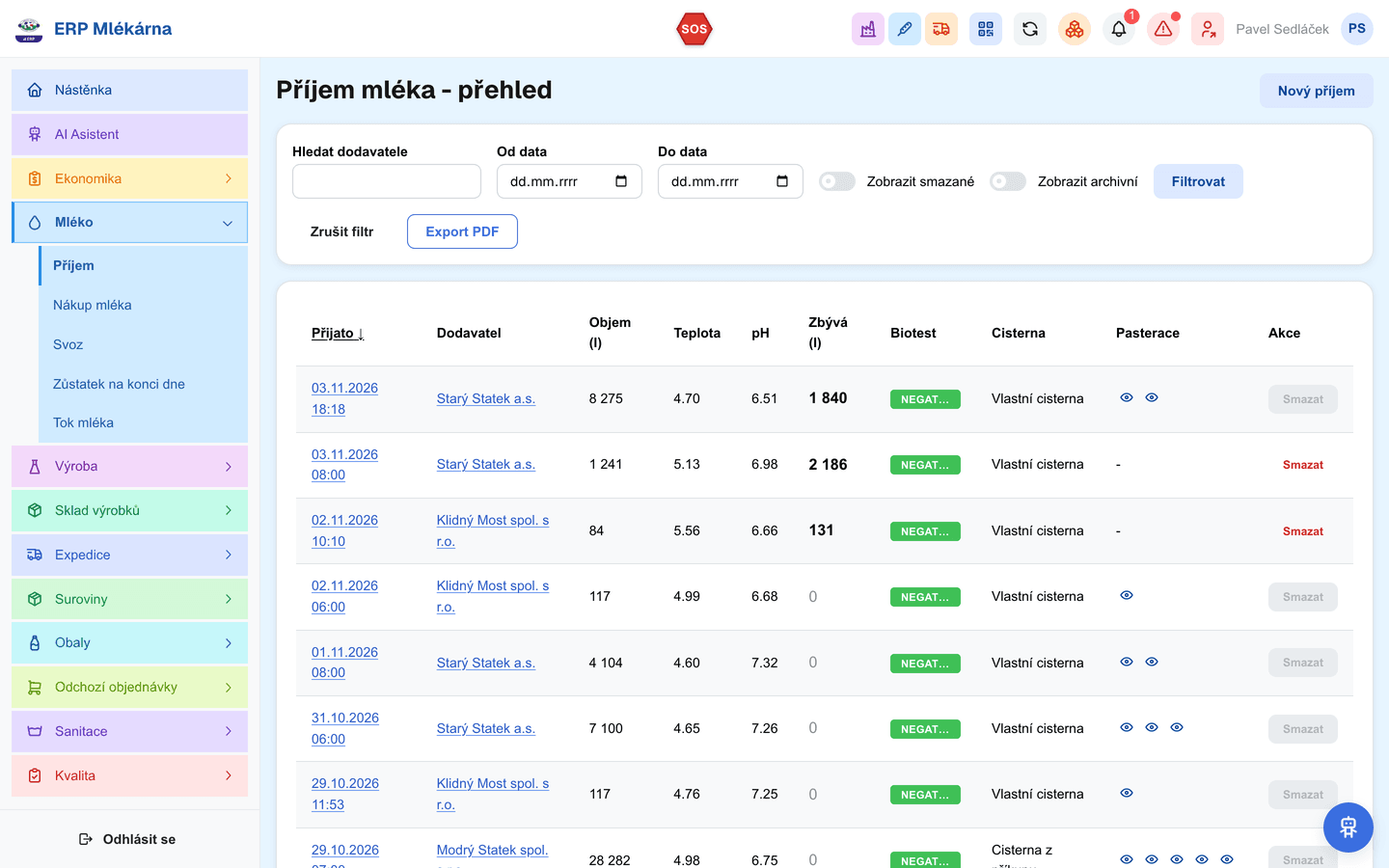
Each production run knows which batches of milk and ingredients it came from. A complaint or an inspection is answered in seconds, not in an afternoon with the binders.
- pasteurisation and milk lots linked to the production run
- shelf life and check weighing on every batch
- ingredients and packaging written off straight from the recipe
Milk
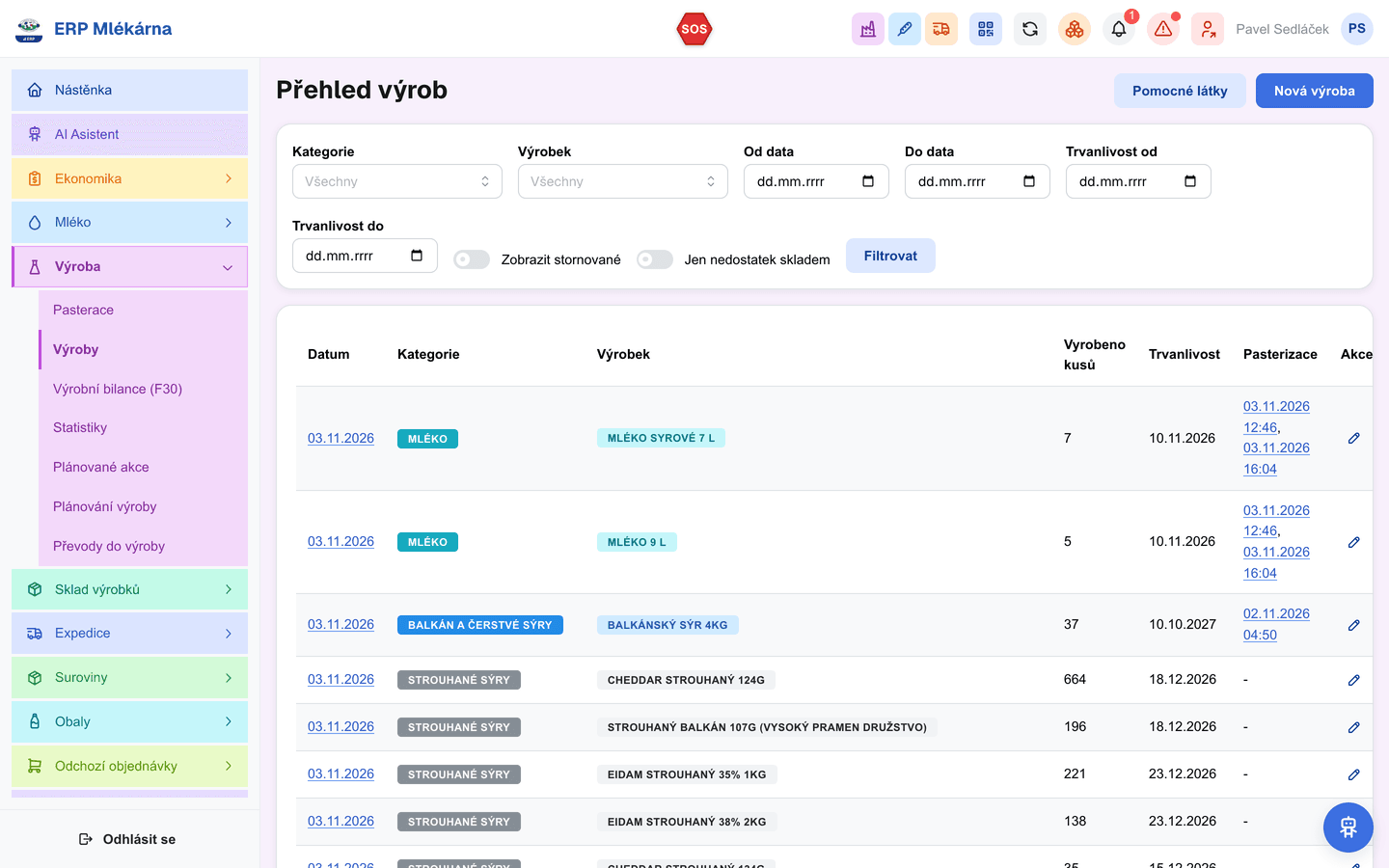
Milk intake with quality control
Every delivery records volume, temperature, pH and the biotest result. The system tracks how much milk is left to process and shows which pasteurisation it went into.
The chain
One figure, entered once
Data flows through the whole company. Whatever is entered at the start is used by every later step, so nothing is re-keyed.
- 01
Milk intake
volume, temperature, pH, biotest
- 02
Pasteurisation
chip confirmation, temperature record
- 03
Production
the recipe writes off ingredients and packaging
- 04
Warehouse
batch, shelf life, coded label
- 05
Dispatch
delivery note with scanned batches
- 06
Invoice
straight into the accounts
- 07
Bank
the payment matches itself, the monthly result
Integrations
What we connected
The ERP does not stand alone. It takes data from services the company already used, from public sources and from devices on the shop floor.
Accounting and bank
- Fakturoid
- bank statements
- ARES
- ČNB rates
Invoices from delivery notes, costs by supplier, bank payments several times a day, companies looked up by registration number.
People
- Giriton
- chips
Attendance, holidays and projects are pulled in automatically. An employee's chip confirms a pasteurisation, a clean-down or a finished task.
Devices on the floor
- Raspberry Pi
- temperature sensors
- cooling
- label printer
- cameras
A small computer in the dairy collects cold-store temperatures, runs the cooling, prints labels and stores camera footage.
Energy
- solar
Generation and self-sufficiency right on the dashboard.
Public and industry sources
- SZIF milk prices
- EKO-KOM
- weather
The average Czech milk price to compare against our own buying, and the figures for the packaging return.
E-mail and AI
- outgoing e-mail
- AI order processing
- AI assistant
Orders to suppliers, questionnaires, alerts. Incoming customer orders are read by AI and entered into the system.
The payoff
What it makes easier day to day
guessing how much to order
The production plan works out the purchase
Pick the products and the period; the system works out ingredients and packaging and turns them into an order.
binders before an audit
Ready for the IFS audit
Logbooks and documents with version history in one place. The consultant can look in from anywhere.
re-typing into invoices
The delivery note is the invoice
The invoice creates itself and the bank payment matches itself against it.
allergens in the technologist's head
Allergens from the recipes
Each product's allergens are derived from its recipe; the overview comes out as a PDF.
forgotten deadlines
A reminder before it is too late
Calibrations, checks and tasks remind you in time. The owner sees what slipped and whose it was.
paper at the line
A phone and a terminal on the floor
Record it at the machine from a phone, scan the batch, confirm with a chip. Done.
Quality
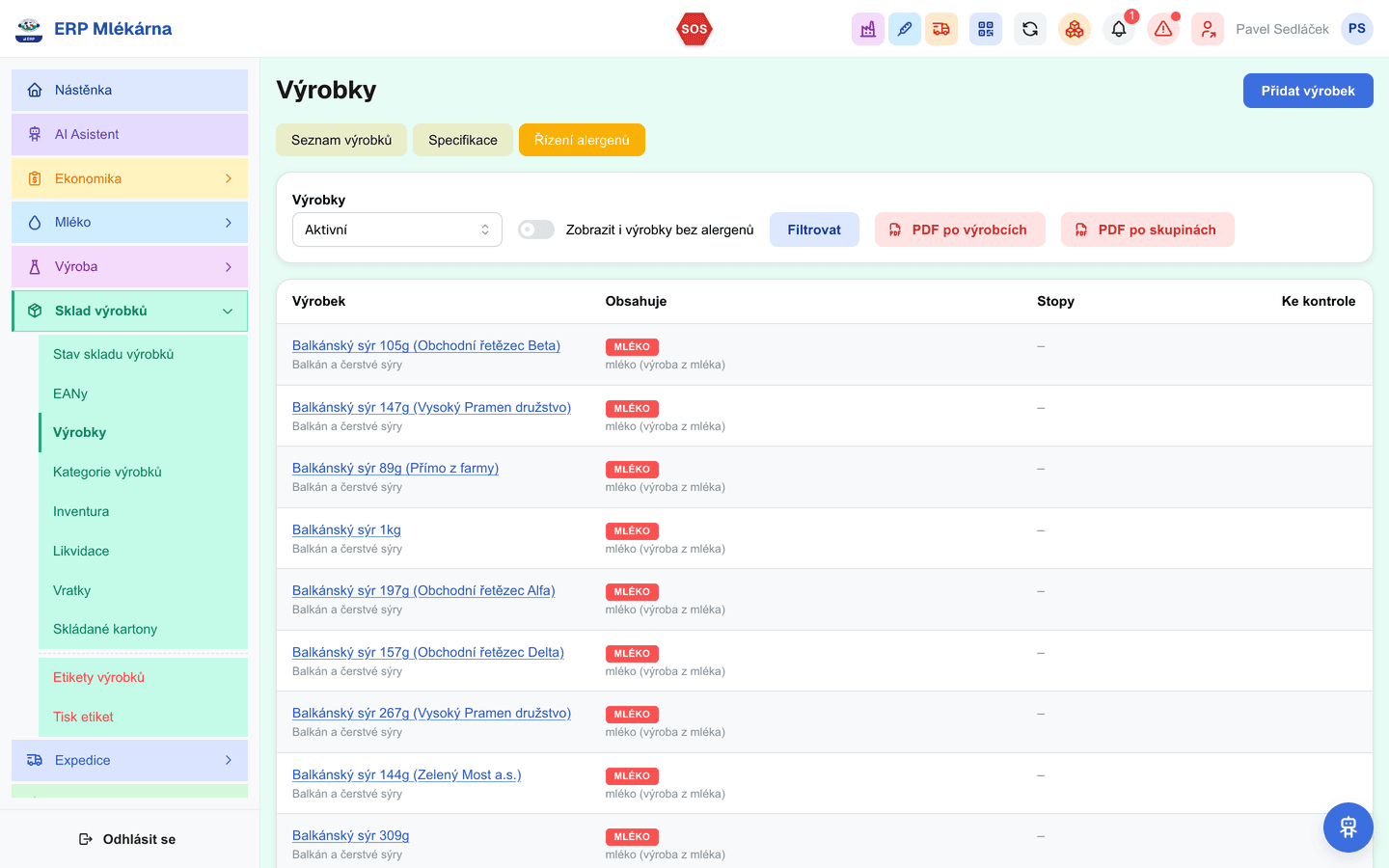
Allergen control as an output, not extra work
The overview is produced from data already in the system. A change of recipe or supplier shows up in it straight away.
Saving · estimate
Four hours a day back
How much time went on re-typing, searching and assembling spreadsheets? We worked it out activity by activity, conservatively.
- saved every day
4 h
saved every day
- use the ERP every day
8 people
use the ERP every day
- of a full-time job freed for work that earns
0,5
of a full-time job freed for work that earns
- estimated saving per year
CZK 413,000
estimated saving per year
Logbooks, sanitation and checks
recorded at the line instead of on paper and re-typed
operators, supervisor75 min15 min−60 minInvoicing and matching payments
invoice from the delivery note, payment matches itself
bookkeeper55 min10 min−45 minProduction plan and orders
ingredient and packaging needs calculated automatically
production manager50 min10 min−40 minFinance and cash flow
the monthly result without spreadsheets
owner35 min5 min−30 minBatches, allergens, audit preparation
traced in a few clicks
technologist30 min5 min−25 minCold-store temperatures
the sensors record them
operators20 min0 min−20 minAttendance and payroll data
pulled from the attendance system
bookkeeper20 min0 min−20 min- Total per day240 min
| Activity | Who | Before / day | Now / day | Saved / day |
|---|---|---|---|---|
| Logbooks, sanitation and checksrecorded at the line instead of on paper and re-typed | operators, supervisor | 75 min | 15 min | 60 min |
| Invoicing and matching paymentsinvoice from the delivery note, payment matches itself | bookkeeper | 55 min | 10 min | 45 min |
| Production plan and ordersingredient and packaging needs calculated automatically | production manager | 50 min | 10 min | 40 min |
| Finance and cash flowthe monthly result without spreadsheets | owner | 35 min | 5 min | 30 min |
| Batches, allergens, audit preparationtraced in a few clicks | technologist | 30 min | 5 min | 25 min |
| Cold-store temperaturesthe sensors record them | operators | 20 min | 0 min | 20 min |
| Attendance and payroll datapulled from the attendance system | bookkeeper | 20 min | 0 min | 20 min |
| Total per day | 240 min | |||
An average hour of work including contributions at CZK 350 = CZK 34,400 a month, 84 hours of work.
The estimate assumes 21 working days a month and a 168-hour month. Besides time, the ERP also saves money that would not fit in the table: less stock past its date thanks to shelf-life watching, no line stopped for missing packaging, lower risk of audit penalties. Those are included as a flat CZK 5,000 a month.
What cannot be counted
A view of the company that cannot be put in figures
The table above counts saved minutes only. The bigger change is that the company can be seen whole, at a single moment — and that brings benefits no estimate can hold.
The whole company on one screen
Milk, production, stock, money and quality at the same moment and from one source. Not five reports assembled after the books close.
Decisions on data, not on a hunch
The milk price, the cost of a job or the monthly result are available straight away. The numbers stopped being argued over, because they come from one place.
A problem shows up sooner
Packaging running low, a calibration coming due or stock nearing its date announce themselves — while putting it right is still cheap.
The company does not rest on one head
Procedures and history live in the system, not in one person's memory. Covering for a colleague or handing work over is suddenly possible.
How it ran
How the project went
No year-long analysis up front. The system grew in small steps and every step went straight into service.
July 2026
Foundation and data migration
Data moved over from the old application, first modules in service.
August 2026
Full operation
Production, warehouses, dispatch, invoices and the bank. Logbooks instead of paper.
September 2026
Finance and quality
Cash flow, supplier scoring and the AI assistant.
October 2026
Audit and hardening
A security audit, backups and hardening.
November 2026
IFS and planning
IFS documentation, allergens and production planning.
Screens
What the system looks like
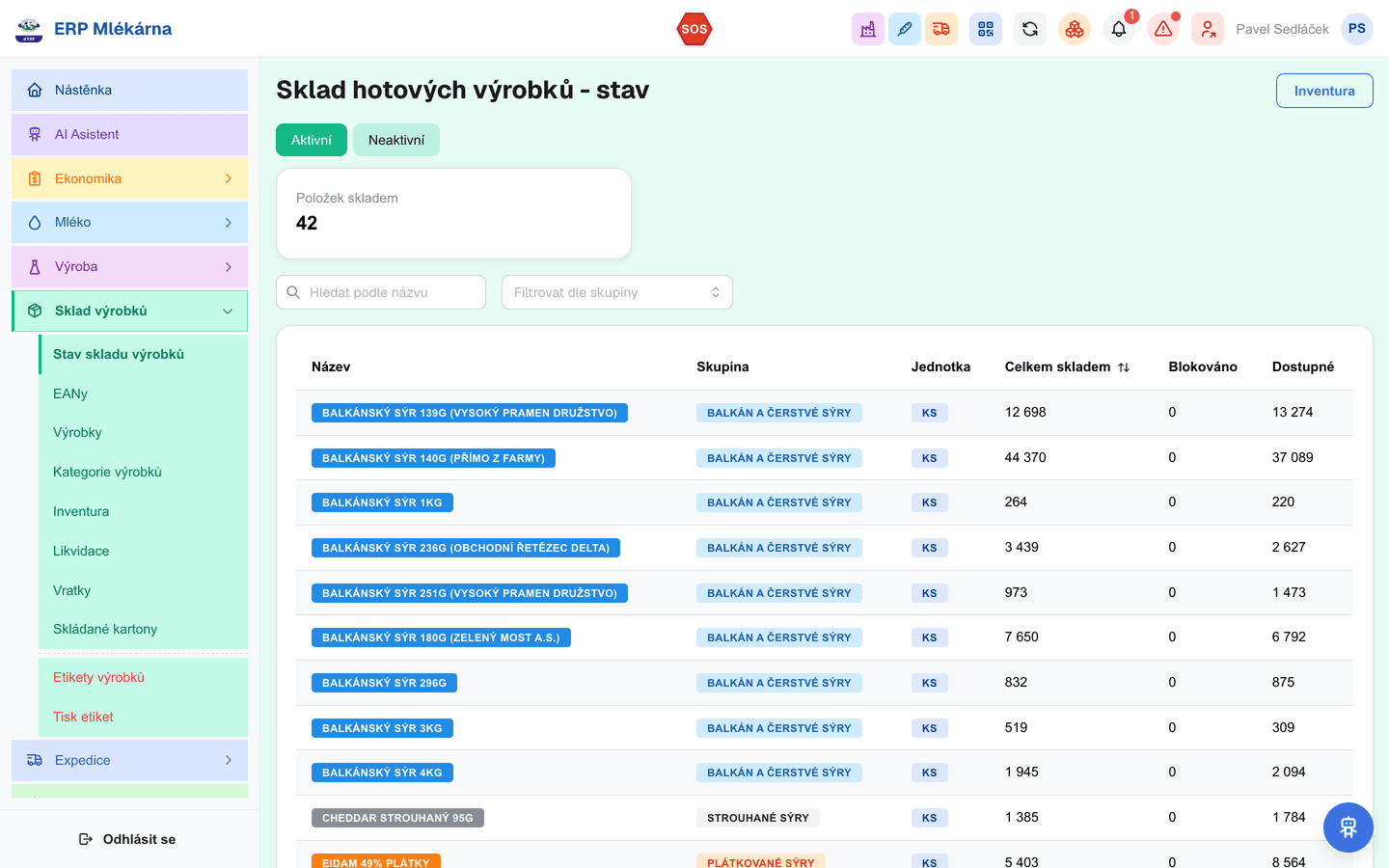
Finished-goods store 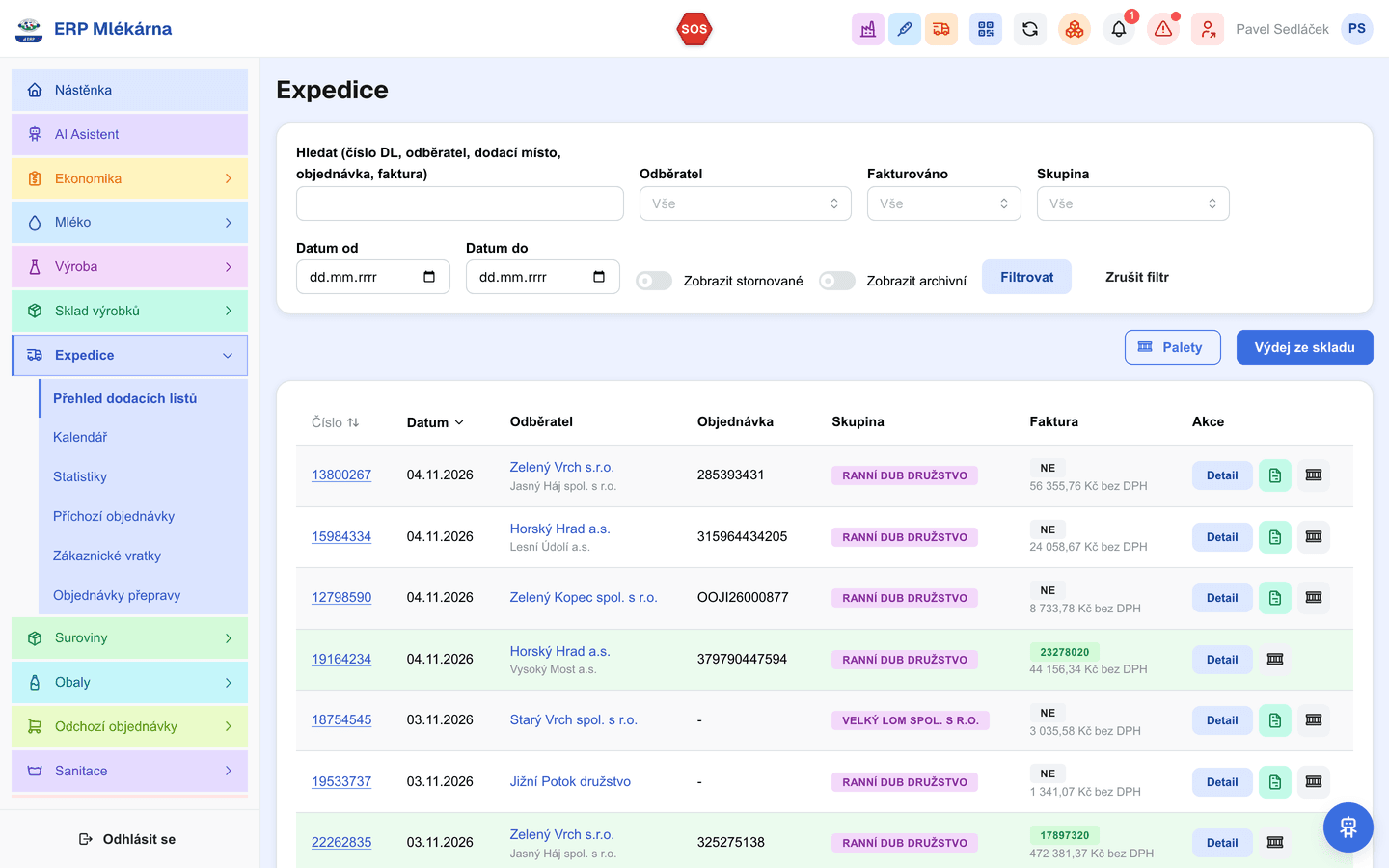
Dispatch and delivery notes 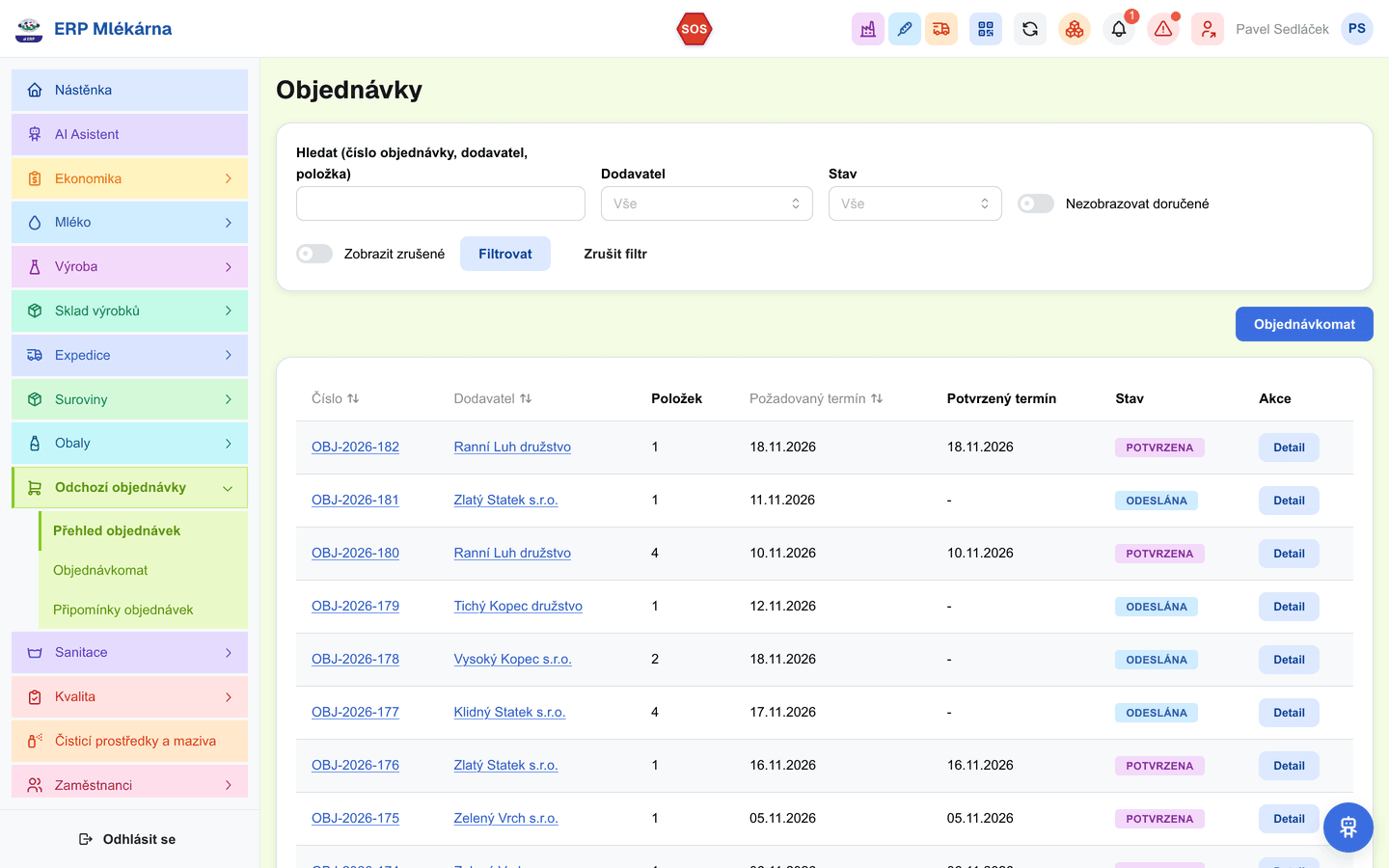
Orders to suppliers 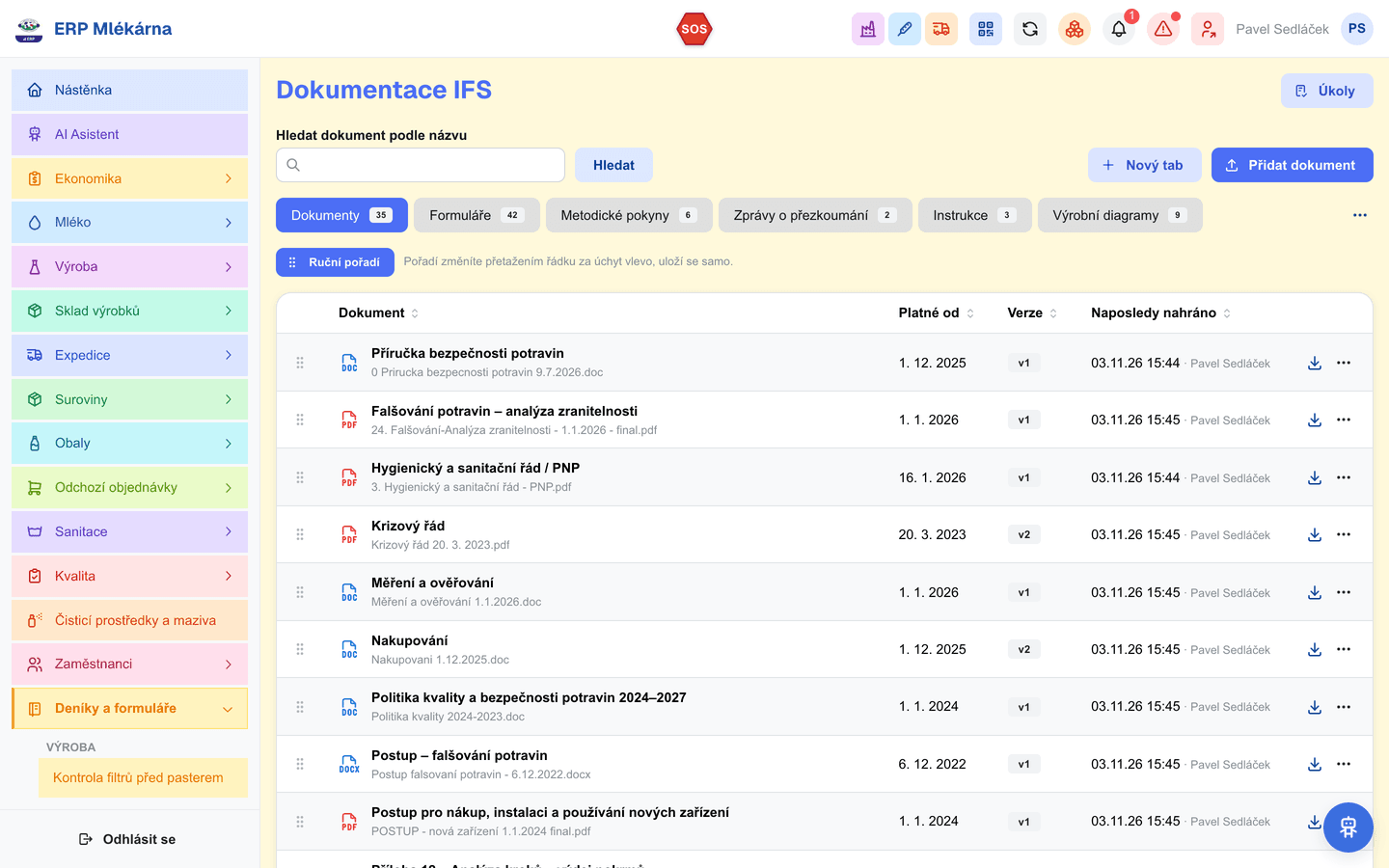
IFS documentation with versions
Want something similar?
A system that adapts to the operation, not the other way round
We are happy to show you how the ERP runs in the dairy for real, and to talk through what would make your own work easier.
The screenshots come from the live system. The names of business partners and people are fictitious and the figures have been altered.